SOIL SALINITY • IRRIGATION • WATER • AGRICULTURE • LAND DEGRADATION
What Is Irrigation-Induced Salinity and Why It Matters for Soil, Crops, and Water Systems
A complete guide to irrigation-induced salinity, including how salts build up in soil, how it affects crops, and proven solutions to prevent and restore salinized land.
Quick Answer:
Irrigation-induced salinity occurs when salts accumulate in soil due to poor drainage, over-irrigation, and evaporation. This reduces crop yields, damages roots, and can lead to long-term land degradation if not managed properly.
Definition:
Irrigation-induced salinity is the buildup of soluble salts in soil caused by irrigation practices that exceed the soil’s ability to drain or flush salts away.
What Is Irrigation-Induced Salinity?
Irrigation-induced salinity occurs when salts accumulate in soil due to irrigation practices that introduce water faster than it can drain or evaporate safely. Over time, salts build up and interfere with plant growth.
What Causes Soil Salinity from Irrigation?
Salinity is caused by poor drainage, excessive irrigation, saline water sources, and high evaporation rates that leave salts behind in the soil.
How Salinity Affects Crops
Salt accumulation disrupts water uptake, damages roots, and reduces plant growth, ultimately lowering yields and crop quality.
How to Prevent Soil Salinity
Preventing salinity involves proper drainage, efficient irrigation, soil management, and using appropriate crop and water systems.
What Is Soil Salinity
<
Soil salinity explained –
A detailed look at how salts accumulate in soil, the difference between natural and irrigation-induced salinity, and how excess salts disrupt water uptake, damage root systems, and reduce long-term soil productivity.
Types of soil salinity
Natural vs human-caused salinity
Salt accumulation in soil
Causes of Irrigation-Induced Salinity
Poor drainage and salt buildup
Over-irrigation –
Applying more water than the soil can absorb or drain causes excess moisture to rise and evaporate, leaving salts behind in the root zone. Over time, this leads to salt buildup, reduced oxygen in the soil, root stress, and declining crop productivity.
Evaporation and salt concentration
Saline water irrigation
Shallow water tables
Irrigation & Salt Transport
Water carries dissolved salts into soil. When water evaporates or drains poorly, salts remain and accumulate over time.
Groundwater Salinity
Saline groundwater used for irrigation can accelerate soil salinity problems.
Capillary Rise and Salts
Salts can move upward from groundwater through capillary action, concentrating near the soil surface.
Climate Change and Soil Salinity
Higher temperatures and drought increase evaporation, leading to greater salt accumulation in soils.
Impact on Crops & Agriculture
Crop yield reduction: Salinity limits plant growth by disrupting nutrient balance and water availability, often leading to smaller plants, fewer fruits, and significantly lower harvests.
Salt toxicity in plants: Excess salts—especially sodium and chloride—accumulate in plant tissues, damaging cells, causing leaf burn, and reducing photosynthesis.
Reduced water uptake: High salt concentrations create osmotic stress, making it harder for roots to absorb water even when soil appears moist, effectively causing “physiological drought.”
Root damage from salts: Salinity can damage root membranes and inhibit root development, reducing the plant’s ability to access water and nutrients over time.
Food production decline: As salinity spreads across irrigated land, entire farming systems become less productive, threatening regional food security and farm viability.
Soil Degradation & Land Loss
Soil structure breakdown: Excess sodium disperses soil particles, destroying aggregation and leading to compacted, crusted soils that restrict water infiltration and root growth.
Reduced fertility: Salinity interferes with nutrient availability and microbial activity, weakening soil health and reducing long-term productivity.
Desertification from salinity: As soils become too saline to support vegetation, plant cover declines, exposing soil to erosion and accelerating desert-like conditions.
Long-term land abandonment: Severely salinized land can become economically unviable, forcing farmers to abandon fields that may take years—or decades—to recover.
Salinization and Desertification
Soil salinization is a major driver of desertification, particularly in irrigated drylands. As salts accumulate, vegetation declines, soil structure collapses, and water retention decreases—creating a feedback loop where degraded land becomes increasingly difficult to restore. Without intervention, productive farmland can transition into barren, desert-like landscapes.
Soil Salinity Management
Leaching and flushing salts: Applying controlled amounts of high-quality water can dissolve and move salts below the root zone, restoring soil conditions when proper drainage is in place.
Improved drainage systems: Subsurface drainage and soil grading prevent waterlogging and allow excess salts to be carried away, reducing accumulation over time.
Salt-tolerant crops: Selecting crops that can withstand higher salinity levels—such as barley, date palms, or certain grasses—helps maintain productivity in affected areas.
Regenerative & Sustainable Solutions
Regenerative agriculture and salinity: Practices like reduced tillage, cover cropping, and soil biology restoration help rebuild soil structure and improve salt resilience.
Organic matter and salt buffering: Adding compost and organic materials increases soil porosity, enhances microbial activity, and helps buffer the negative effects of salts.
Biochar and soil health: Biochar improves soil structure, increases water retention, and can help bind salts, reducing their impact on plant roots.
Agroforestry and water balance: Tree-based systems improve water infiltration, reduce evaporation, and stabilize soils—helping prevent salt accumulation over time.
Crop Circle Farms: Water-efficient growing systems that optimize irrigation, reduce runoff, and improve soil hydration can significantly lower the risk of salinity buildup in managed landscapes.
Comparison: Saline Soil vs Healthy Soil
Category
Saline Soil
Healthy Soil
Plant Growth
Poor or stunted growth
Strong, balanced growth
Water Uptake
Restricted by salt stress
Efficient root absorption
Soil Structure
Compacted, crusted, or degraded
Stable, porous, and well aggregated
Productivity
Low yields and declining fertility
Higher yields and long-term fertility
Global Salinized Land Area
Large areas of irrigated land worldwide are affected by salinity, reducing agricultural productivity and threatening food systems.
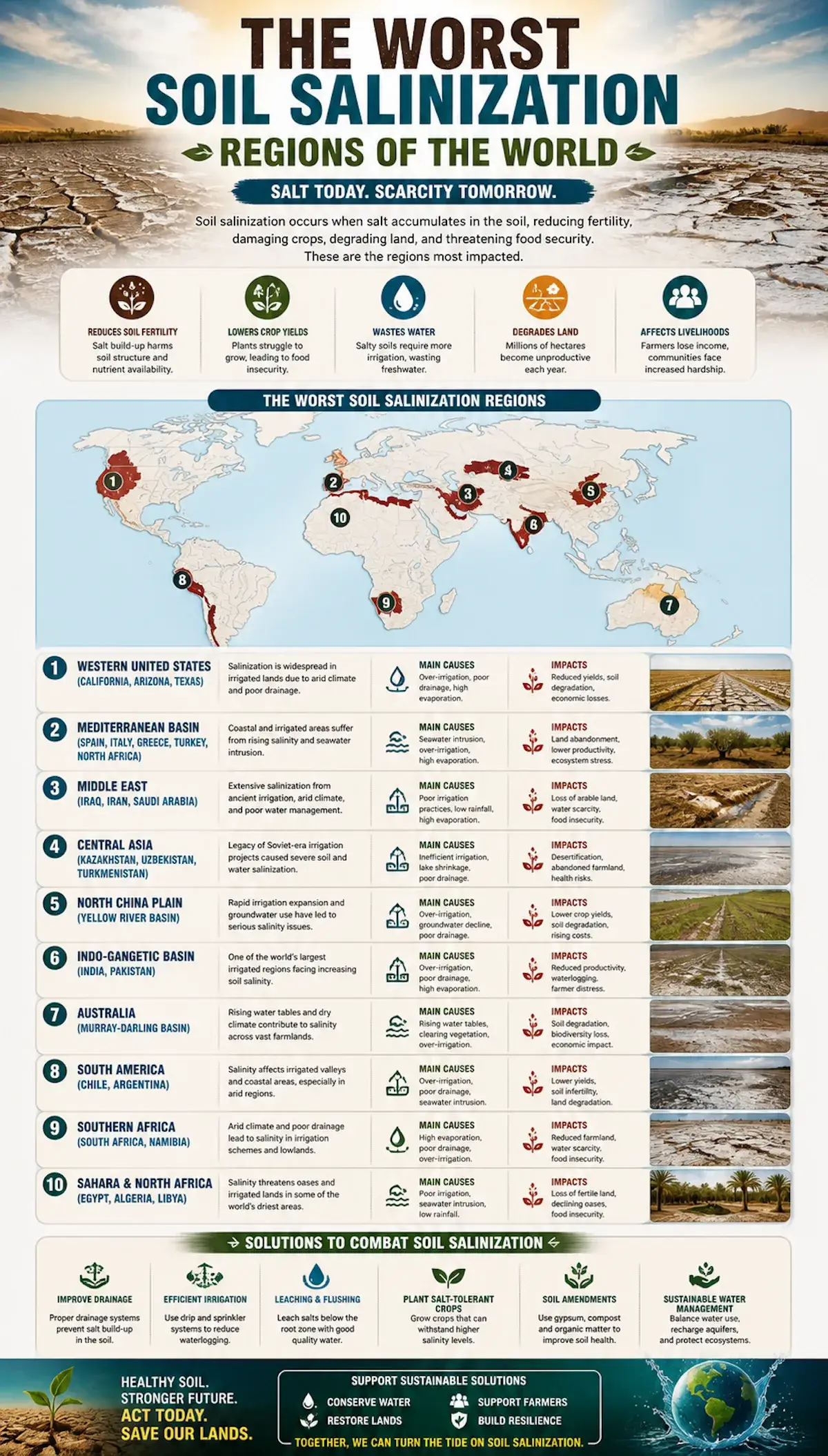
Worst Soil Salinization Regions of the World Infographic
Feel free to share this soil salinization infographic explaining how salt buildup, poor drainage, over-irrigation, seawater intrusion, declining crop yields, land degradation, and water scarcity are impacting major agricultural regions around the world. Please include a link back to this page as the source.
Share This Soil Salinization Infographic
Copy and paste the embed code below.
Tipping Points
Soil salinization becomes especially dangerous when salt accumulation moves beyond a level that crops, soil biology, and irrigation systems can recover from naturally. At first, salinity may only reduce yields slightly. Over time, however, salts concentrate in the root zone, water becomes harder for plants to absorb, soil structure begins to fail, and each growing season becomes less productive than the one before.
These tipping points are often reached slowly, then suddenly. A field may appear manageable for years until poor drainage, repeated irrigation, drought, rising groundwater, or seawater intrusion pushes the soil past a critical threshold. Once that happens, restoration becomes much more expensive, and in severe cases the land may be abandoned.
Irreversible soil salinization: Salt levels rise so high that normal rainfall, irrigation, and crop rotation are no longer enough to flush salts below the root zone.
Crop failure threshold: Sensitive crops begin to decline first, followed by moderate-tolerance crops as salts interfere with seed germination, root growth, and nutrient uptake.
Soil structure collapse: Sodium-rich soils can lose their crumb structure, becoming compacted, crusted, and slow to absorb water.
Drainage failure: When water cannot move through the soil properly, salts remain trapped near plant roots and continue building season after season.
Rising water tables: Shallow groundwater can pull salts upward through capillary action, especially in hot, dry climates where evaporation is high.
Seawater intrusion: Coastal farms can reach a tipping point when groundwater pumping allows saltwater to move inland and contaminate wells and soils.
Permanent yield decline: Once salinity reaches advanced levels, farmers may need more water, more amendments, and more energy just to produce less food.
Land abandonment: In the worst cases, salinized fields become uneconomic to farm, reducing local food production and damaging rural livelihoods.
The most important warning signs include white salt crusts on the soil surface, stunted plants, poor germination, standing water after irrigation, reduced yields, and increasing need for irrigation without improved crop performance. These signals indicate that the soil-water balance is breaking down and that immediate intervention may be needed.
FAQ • SOIL SALINITY
Irrigation-Induced Salinity FAQ
The buildup of salts in soil due to irrigation practices.




 INVEST
 PLANT
PLANT
 SOFTWOODS
 HARDWOODS
 CALCULATORS
 RESOURCES
 REFOREST